Search Results
Search Results
Search this site
108 results found with an empty search
- Spring tips on helping injured wildlife
~Story in Parksville Qualicum Beach News - Sam Duerksen | photo from video taken by Agatha Lloveras Delgado~ In this article, Derek Downes, animal care supervisor at North Island Wildlife Recovery Centre, offers tips on ways to help injured animals or unnested birds. You can view the PQB News article and video here. You can help the wildlife in care at NIWRA by making a financial contribution on our secure website. Thank you so much for caring about wildlife!
- WHOO, WHO are you? - the most vocal owl is the Barred Owl.
~Update on our resident barred owls~ The barred owl is the most vocal of the owls, uttering the familiar WHOO, WHOO, WHO call. It also utters a variety of other sounds. It is a medium-sized owl and is characterized by the barred colour pattern on its chest and abdomen (hence its name). The females are slightly larger than the males. The barred owl is a light and graceful flyer. It seldom soars but can fly at great heights to elude harassing crows. It is very agile in the thick forest, using its short wings to maneuver between branches. Its favourite prey is rodents, mainly rats and mice. They will also eat birds, snakes, insects, frogs, bats and even fish. Their feet and talons are small for their size, so they tend to carry prey in their beaks. There are four resident non-releasable Barred Owls at NIWRA. One-Eye and Eye-Gone have wing and eye injuries, likely from vehicle collisions. Oliver is gloved trained and a popular animal ambassador. Quinn was struck by a car while hunting on the roadside and is blind in one eye. Oliver suffered a wing injury as a nestling and was being raised for release, but unfortunately his wing never fully healed and he is not capable of sustained (or silent) flight. Both Quinn and Oliver were very young when they were injured and deemed non-releasable, so they were raised intentionally as Animal Ambassadors and are part of our education program. Quinn and Oliver check out visitors - WHOO are you staring at!? You can help the wildlife in care at NIWRA by making a financial contribution on our secure website. Thank you so much for caring about wildlife!
- This clean up crew is fascinating!
~Some cool facts about our resident turkey vultures~ Turkey vultures are called “Nature’s garbage collectors” by some; it’s widely believed that they eat anything dead but they prefer their ‘meals’ to be no more than 3 days old. Turkey vultures have keen eyesight and a razor-sharp sense of smell. A large nasal cavity in their beak helps them detect a carcass from great distances. This nasal cavity goes from one side of the beak to the other, and the vulture can clean it out with its talon. Not the prettiest predator at NIWRA, but turkey vultures are one of the most fascinating! The vulture can put its featherless head into a rotting carcass without soiling or damaging its feathers or contacting diseases. Bacteria left on the vulture's head will be killed by the sunlight, and it is thought that their strong digestive juices kill most harmful bacteria. They defecate on their legs to disinfect them. If they feel threatened, a turkey vulture can projectile-vomit up to 3 meters (10’) as a means of defense. Come check out Anastasia, Boris, Igor and Vladimir -- our resident turkey vultures, the next time you visit NIWRA, but be sure to keep your distance! Two of our resident turkey vultures suffered damage to their wings and do not fly well enough for release. The other two had ingested some form of toxic substance that disrupted their feather quality and makes them poor flyers as well. You can help the wildlife in care at NIWRA by making a financial contribution on our secure website. Thank you so much for caring about wildlife!
- Eagle release was a great success!
~April 1 eagle release at NIWRA~ Over 600 people were onsite to witness the exciting release back to the wild of a rehabilitated bald eagle on Saturday April 1. It was the first public release since before Covid. Ignoring the big crowd, the eagle was very focused on the sky as he was released. While the weather was mixed rain, hail and snow prior to the scheduled release time, it luckily cleared up so the eagle release could go ahead. Denise Foster of the French Creek Estuary Nature Preserve had the honour of releasing the eagle, a wounded warrior now ready to go back into the wild. And we have lift off! You can read more about the eagle release in local news features from PQB News here and Chek News here. You can help the wildlife in care at NIWRA by making a financial contribution on our secure website. Thank you so much for caring about wildlife!
- It's been a thrill to watch Casey growing up!
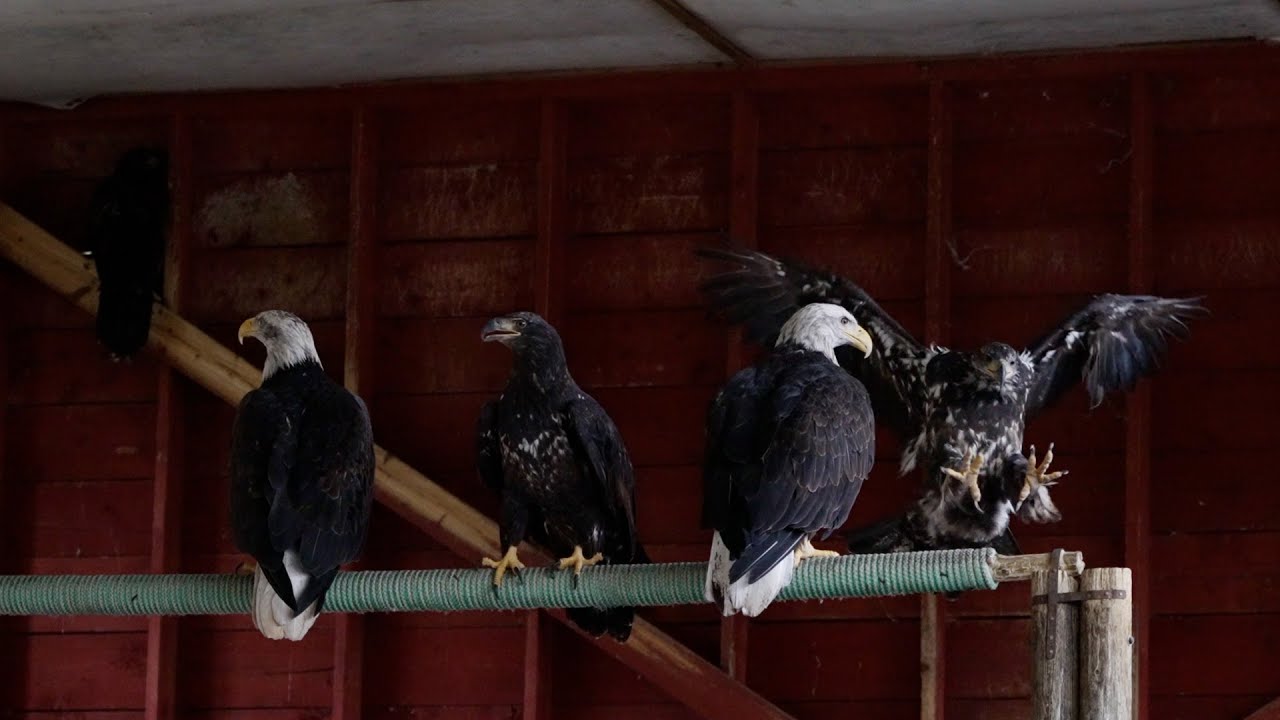
~Update on one of our resident bald eagles~ Casey came to NIWRA on May 17, 2019 as an injured eaglet who cannot be released back into the wild. He is a permanent resident at the centre because he is unable to fly due to a non-repairable dislocated wing. Regular visitors have enjoyed watching Casey's transformation over the years from a super cute eaglet to a handsome young adult bald eagle. Who's a handsome fellow now?! Casey has been aging distinctively before our eyes. Bald eagles do not attain their distinctive adult colouring until they are around 5 years of age. As young birds, their plumage, eyes and beaks are dark brown. After the first year, the plumage becomes increasingly variable with pale mottling. After the 2nd year, their eyes and beaks begin slowly changing to yellow. Casey at the juvenile stage. Juvenile bald eagles are often mistaken for golden eagles who don’t have the white head and tail or the yellow legs, beak and eyes. What a cute baby Casey was when he first came to NIWRA! You can learn more about Casey here. You can help the wildlife in care at NIWRA by making a financial contribution on our secure website. Thank you so much for caring about wildlife!
- Bear Necessities: Wildlife centre a place to heal before returning to the wild
Story by Times Colonist - By Darron Kloster | Photo by NIWRA North Island Wildlife Recovery Centre near Errington cares for everything from orphaned bear cubs to raptors struck by vehicles, getting them ready to return to the wild if possible. Read the full Times Colonist story HERE. Your support means everything to these animals! You can help by dropping off donations of blankets, towels, sardines or tuna (packed in water), eggs, applesauce, berries, wild fish or game meet or by making a financial contribution on our secure website. You can also help the wildlife in care at NIWRA by making a financial contribution on our secure website. Thank you so much for caring about wildlife!
- Five Black Bear Cubs Enjoy Pumpkins for the First Time!
Update on the 5 Black Bear cubs admitted to NIWRA in 2022. The young Black Bear cubs admitted to NIWRA in 2022 are being raised up for release back into the wild where they belong in the spring/summer of 2023. They were given a complete physical checkup in October and are all very healthy and growing like weeds. Our Animal Care team gave them several fresh pumpkins as a treat and they had a lot of fun playing and eating! They spend most of their time rough-housing, eating and snoozing. When you visit, you can view these youngsters on closed-circuit tv. They are delightful to watch. Your support means everything to these animals! You can help by dropping off donations of blankets, towels, sardines or tuna (packed in water), eggs, applesauce, berries, wild fish or game meet or by making a financial contribution on our secure website. We will keep you updated on the progress of these youngsters. You can help the wildlife in care at NIWRA by making a financial contribution on our secure website. Thank you so much for caring about wildlife!
- Critter Rescue Q&A
Story from VITA Daily Magazine | Photo by NIWRA An organization in B.C., the North Island Wildlife Recovery Association, does important work caring for ill, injured and orphaned wildlife and educate the public on wildlife and environmental issues. Go to https://vitadaily.ca/2022/10/05/critter-rescue-qa/ to read the full story. You can help the wildlife in care at NIWRA by making a financial contribution on our secure website. Thank you so much for caring about wildlife!
- Casey the Bald Eagle - Animal Ambassador
Casey is a bald eagle that has become a permanent resident at the North Island Wildlife Recovery Centre in Errington, British Columbia. Animal Care Supervisor Derek Downes helps Casey live his best life at the center, as he is unable to fly due to a non-repairable dislocated wing. Video and story by SHAW Spotlight - Matthew Hoffman, Producer How You Can Help the Animals at NIWRA Your support means the world to the animals! You can help by dropping off any of the items on the wish list below, or by making a financial contribution through our secure website. THANK YOU!
- Triplet Bear Cubs Admitted - Total Cubs in Care Now Five!
3 orphaned cubs admitted from the Oceanside area bring the total count to to 5 cubs in care at NIWRA. Two brothers and sister bear cubs were admitted to the centre late in the day on Wednesday, July 13, 2022. Our Animal Care team will ensure these little ones receive the specialized care they need to have their best chance to grow and be released back into the wild where they belong. Cubs remain at NIWRA for an average of 15 months before they are ready for release and cost more than $40 per day while in care. Your support means everything to these animals! You can help by dropping off donations of cottage cheese, yogurt, apples, applesauce, eggs, fish oils (tuna, sardines, etc.), or by making a financial contribution on our secure website. We will keep you updated on the progress of these three babies, the cub that entered a house through a cat door and the first cub admitted this year. Thank you so much! You can help the wildlife in care at NIWRA by making a financial contribution on our secure website. Thank you so much for caring about wildlife!
- Sacred White Raven of Oceanside on Public Display at NIWRA!
North Island Wildlife Recovery Association is very happy to announce that Blizzard is now viewable by the public. Blizzard is nicely settling into his special new enclosure. We want to thank everyone for their continued interest and kind wishes. We really hope that everyone can come see this beautiful rare bird! We ALWAYS welcome donations of eggs and berries, especially blueberries, blackberries and raspberries. Thank you so much! You can help the wildlife in care at NIWRA by making a financial contribution on our secure website. Thank you so much for caring about wildlife!
- Volunteering at NIWRA is FUN!
If you are passionate about wildlife, volunteering at NIWRA may be a perfect match for you! We are always looking for awesome people to join our team of awesome people! Volunteer Application Here You can help the wildlife in care at NIWRA by making a financial contribution on our secure website. Thank you so much for caring about wildlife!
- North Island Wildlife Recovery Centre Featured as BC Bird Trail Story!
NIWRA Animal Care Supervisor, Derek Downes shares the important work NIWRA does to rehabilitate Bald Eagles on Vancouver Island. Check out BC Bird Trail on Facebook, Instagram or Twitter You can help the wildlife in care at NIWRA by making a financial contribution on our secure website. Thank you so much for caring about wildlife!
- Black bear cub rescued from Vancouver Island tree, taken to wildlife centre
Story from Nanaimo News Bulletin - Tyson Whitney | photo by Cathy Anderson A black bear cub with an uncomfortable comfort level with Port Alice was plucked from a treetop yesterday in the hopes it can be safely released back in to the wild. Go to https://www.nanaimobulletin.com/news/black-bear-cub-rescued-from-vancouver-island-tree-taken-to-wildlife-centre/ to read the full story. You can help the wildlife in care at NIWRA by making a financial contribution on our secure website. Thank you so much for caring about wildlife!
- Beautiful Rae
A big, heart-felt thank you to everyone who sent love and concern for Rae when we lost Knut on July 20, 2021. Your care for wildlife means the world to us! Rae came to us as an orphaned, Vancouver Island Black Bear cub in 2017 with a head injury and suffering from seizures. Thanks to the specialized care she received from our Wildlife Veterinarian, Dr. McAdie, as well as our dedicated Animal Care Team, Rae has done very well and has not had a seizure over the past eight months. When we first introduced Rae to Knut, our slow-moving, senior bear, he wasn’t quite sure what to make of her. Knut had his own routines and young Rae was determined to turn him into a playmate. Knut did his best to ignore and tell her to leave him alone, but she persistently pestered him until he finally gave in and began to play and respond to Rae’s constant shenanigans. It wasn’t long before people noticed that Knut had a new spring in his step. His increased activity level was great for his overall health and the two bears were often seen wrestling, swimming and hanging out together. When we lost Knut, Rae grieved for her companion. Fortunately, in addition to our amazing animal care team we have enlisted a knowledgeable volunteer who has a relationship with Rae to spend several hours each day with her for reassurance and companionship and help her through this challenging time. Rae is a happy bear by nature, and she is again playing, exploring her re-vamped enclosure and enjoying her special treats. She has been splashing in the big tub to the delight of everyone who works or visits here. Rae has access to a cool building where she can escape the heat of summer. Rae is a NIWRA poster girl! Her beautiful image can be seen on a highway billboard and other advertisements and publications. She is very photogenic, and we never get tired of seeing new photos of this amazing animal. We hope Rae is out and about when you come to visit. She is a delight to us all and we promise to take excellent care of her. Thanks for your support! You can help the wildlife in care at NIWRA by making a financial contribution on our secure website. Thank you so much for caring about wildlife!